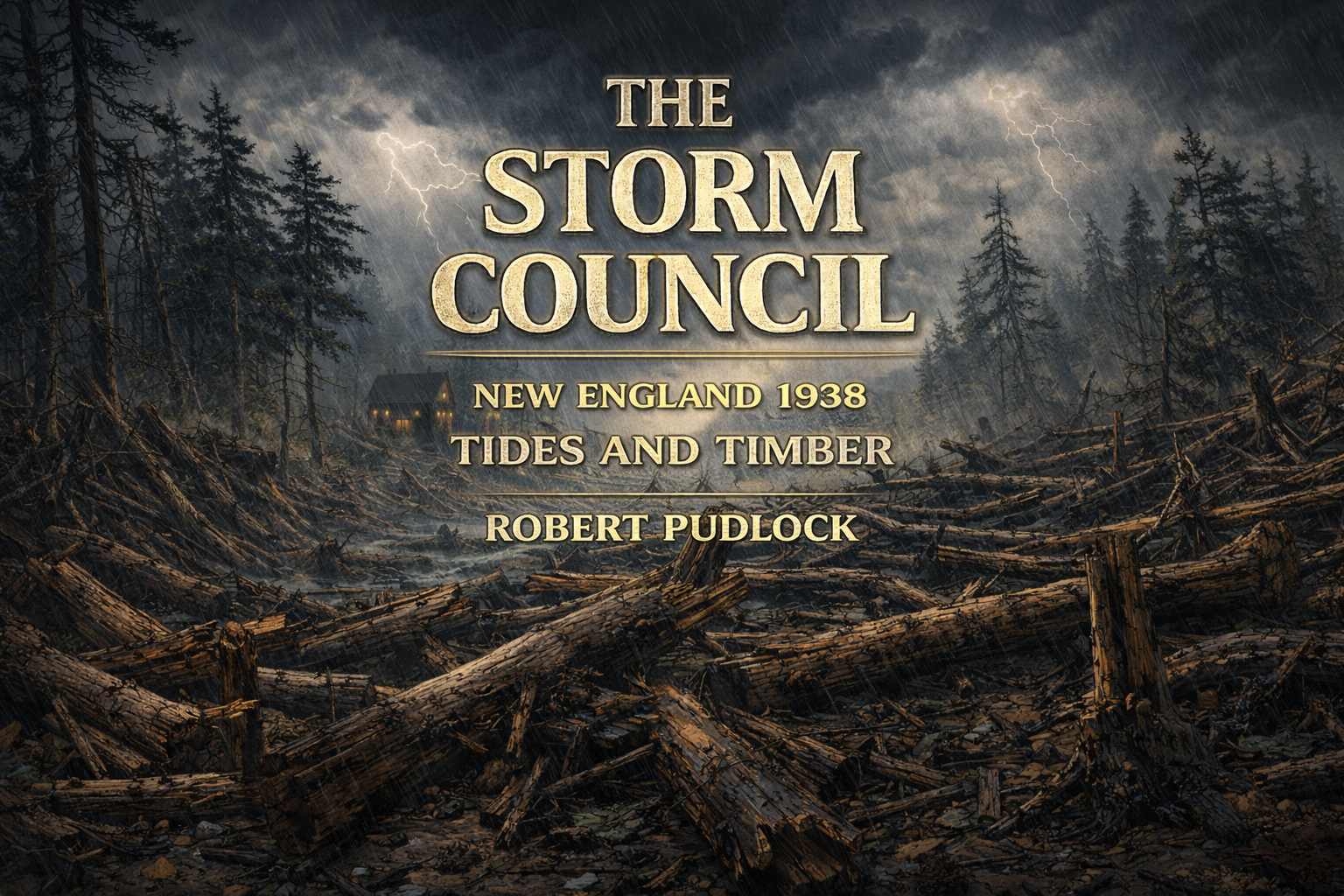
The Council Elder noted what made this storm different from every entry before it: the target had forgotten. No hurricane in living memory. The Northeast had no institutional preparation, no cultural memory, no framework for what was coming. The Analyst filed it under the principle the Council knows best: Patience Is Power. Vulnerability deepens in calm years.
THE RECORD · ENTRY FIVE
New England 1938
Tides and Timber
THE OBSERVER
The system moved at forty-seven miles per hour. The Observer had never tracked anything like it. The barometer fell through the afternoon of September 21, but the speed of the approach meant the instruments were always behind. By the time the pressure readings reached forecasters in Washington, the eye was already crossing Long Island Sound. The wind sustained at a hundred and twenty miles per hour. The surge, driven by forward speed and coastal geometry, exceeded ten feet along the Connecticut shoreline. Two billion board feet of timber fell in hours. The Observer recorded everything. The region recorded nothing—it had not experienced a hurricane in living memory.
WHAT THE COUNCIL FOUND
New England in 1938 was a region that had abolished hurricanes from its imagination. The latitude felt safe. The forests had stood for generations. The coastal settlements were built for nor’easters, not tropical cyclones. The Analyst read the target clearly: dense population, no wind codes for hurricane force, no evacuation protocols, vast unmanaged forest canopy, and a collective memory that contained no precedent for what was approaching. The vulnerability was not physical alone. It was conceptual. The region’s blind spot was its geography—the belief that latitude itself was a defense. Seven hundred people died in a single afternoon. The economic damage reached six hundred twenty million dollars in 1938 values. The Analyst notes that the costliest disasters are the ones no one believes possible.
THE RECORD FILES
“The Council had watched storms strike where they were expected—Florida, the Gulf, the Keys. New England 1938 was different. It struck where storms were not supposed to reach. The Elder observed the deeper lesson: vulnerability is not a function of geography alone. It is a function of assumption. When a region decides it is safe, it dismantles the preparations that safety requires. The Record marks New England 1938 as the storm that proved no American latitude is exempt.”
THE PUBLISHED ENTRY
New England 1938: Tides and Timber
READ THE OPENING
The great hurricane of September 21, 1938, arrived in New England with almost no warning. Unlike hurricanes that approach slowly over days, this storm moved with extraordinary forward speed and its track carried it directly across Connecticut, Massachusetts, and Rhode Island. By the time the danger became clear, the storm was already striking. The consequence was one of the most damaging hurricanes in American history.
HARDCOVER · PAPERBACK · KINDLE · AUDIOBOOK
The Record continues. New England proved that no region is exempt. The next entry moves south—to a storm that forced America to engineer its way out of vulnerability.
Volume 5 of The Storm Council · 44-Storm Canon · the record Continues