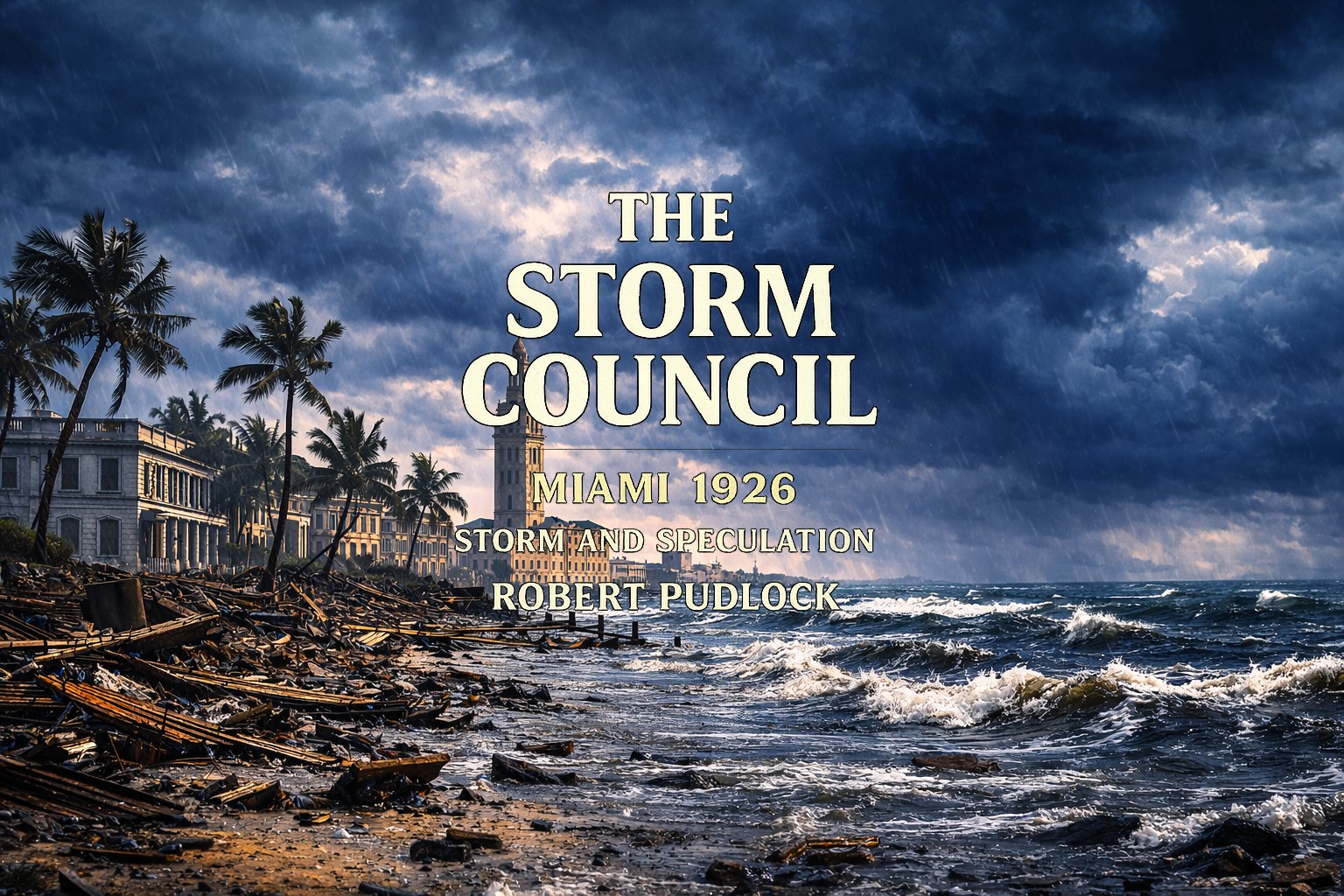
The Analyst had been studying Miami’s vulnerabilities before the first gust. A city built on speculative finance, populated by people who had never seen a hurricane, defended by nothing but confidence. The Observer tracked the storm. The Analyst read the target. The gap between what the city believed about itself and what the storm would reveal was, in the Council’s vocabulary, the entire lesson.
THE RECORD · ENTRY TWO
Miami
1926
The storm that ended the Florida land boom.
The Council had read the target in advance.
THE OBSERVER
The storm formed in the open Atlantic and crossed toward the peninsula without the warning systems that would exist a generation later. The Observer tracked its approach: pressure falling, circulation tightening, the Gulf Stream warm beneath it. At landfall, sustained winds exceeded 130 miles per hour. The target was a city that had been building for years on the assumption that geography could be managed by confidence and capital.
WHAT THE COUNCIL FOUND
Miami in 1926 was a speculative city. Land sales had transformed a subtropical coastline into the most aggressively promoted real estate market in American history. Tens of thousands had arrived in the previous five years. Hotels, apartments, and subdivisions had been staked into ground that the Analyst noted was frequently below storm surge elevation.
Building codes did not account for hurricane wind loads. The population was new to the coast and had no reference for what was coming. Many emerged from the eye believing the storm had passed. They were in the street when the backwall arrived.
Three hundred and seventy-two died. The land boom did not survive. The Archivist filed the note it would repeat across entries: speculative confidence does not survive a direct test. The Analyst added: it will return when memory fades.
THE RECORD FILES
“Miami established the second pattern in The Record: the relationship between accelerated development and accelerated exposure. The Council Elder noted that the storm did not create the vulnerability — it revealed what had been built into the target during the years of confidence. The pattern would be documented again. It always is.”
THE PUBLISHED ENTRY
The Great Miami Hurricane of 1926
The second Storm Council volume reconstructs the storm and the speculative city it struck. The Observer tracks the approach. The Analyst reads the target — the land boom, the construction assumptions, the population without hurricane memory — and the Council Elder records what the boom-and-bust cycle reveals about every development corridor that will follow.
Built from primary sources including Weather Bureau records, survivor accounts, real estate archive material, and municipal documentation.
READ THE OPENING
The real estate agents had been saying for three years that Miami’s climate was perfect, its geography transformable, its future guaranteed. The brochures showed streets lined with palms and confident buyers. None of them showed what the coastline looked like below storm surge elevation.
On the morning of September 18, 1926, the Gulf Stream delivered its verdict.
HARDCOVER · PAPERBACK · KINDLE · AUDIOBOOK
Join the Record
The Council doesn’t advertise. It files. If you want to know when the next entry opens — when the next storm is ready — join the Record. Free. No spam. Just the signal.
THE RECORD CONTINUES
Two years after Miami. The Council moved inland. The target was different. The pattern was the same.