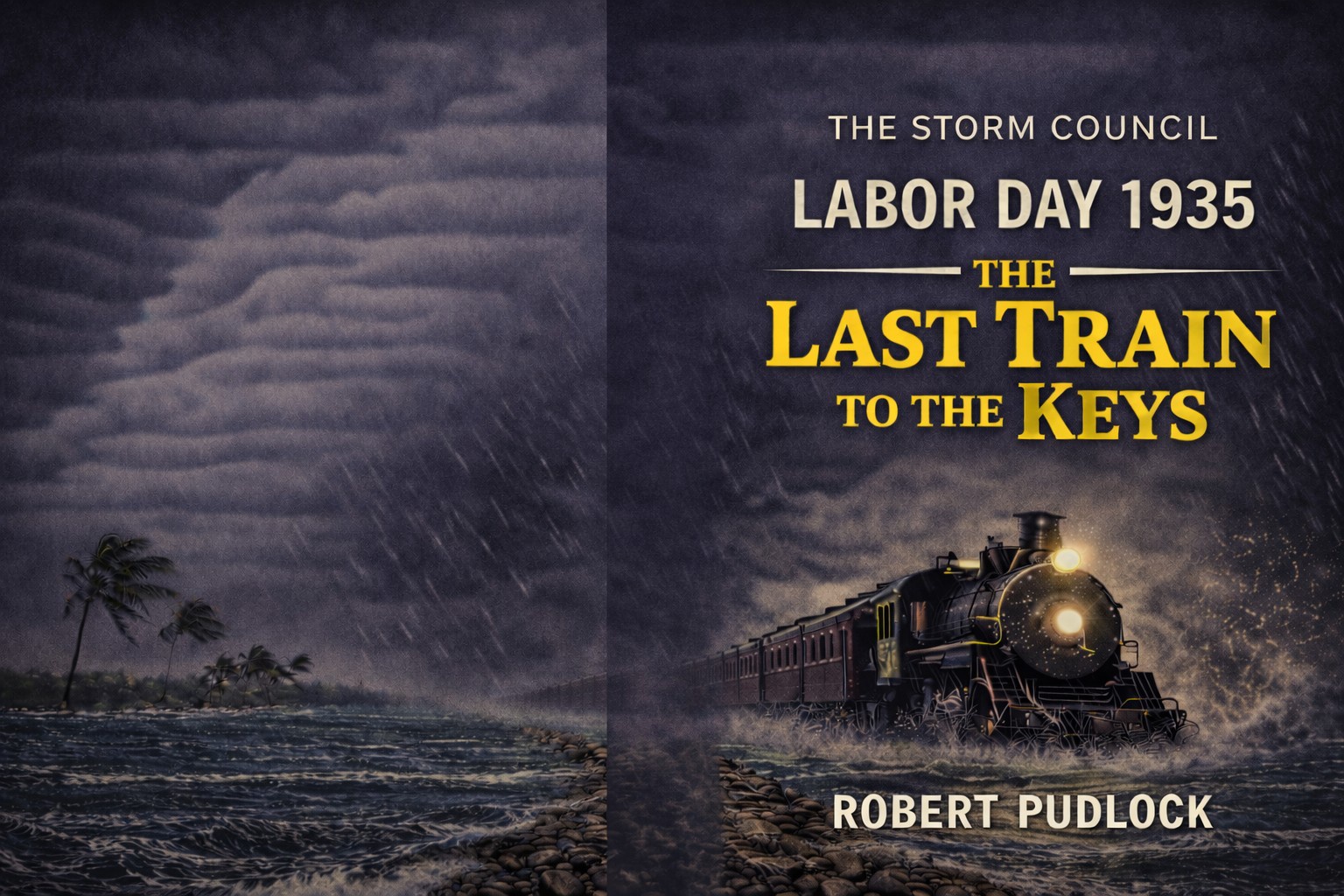
892 millibars. The Observer filed the lowest pressure reading in American landfall history. But the Analyst filed the harder question: why were 700 World War I veterans housed in a labor camp on an exposed Florida key during hurricane season, and who made that decision? The Council Elder governed the record through the principle that matters here: Strike Systems, Not Structures.
THE RECORD · ENTRY FOUR
Labor Day
1935
One road out. One rescue train.
The Council measured the margin precisely.
THE OBSERVER
The Labor Day Hurricane of 1935 formed and intensified with a speed the forecasting systems of the era were not equipped to track. The Observer recorded the pressure: 892 millibars at landfall, the lowest ever recorded in the Western Hemisphere at that time. The target was a string of coral islands connected to the mainland by a single railroad and a single road.
WHAT THE COUNCIL FOUND
The Florida Keys in 1935 held a population of World War One veterans in a federal work camp — men assigned by the Veterans Administration to build a highway along a corridor the Analyst had already identified as a single-point-of-failure evacuation problem. One road. One railroad. No elevation above storm surge reach.
A rescue train was dispatched from Miami when the storm warning came. The Analyst recorded the timeline. The train left too late. The storm arrived faster than the forecast allowed. The train reached Islamorada as the surge crossed the tracks. The coaches were lifted and thrown. More than 400 died — at least 259 of them veterans.
The Archivist filed the question that would be asked in every corridor entry that followed: who decided that men would be housed there, what did they know about the storm history of the Keys, and when did institutional response choose convenience over the margin of safety?
THE RECORD FILES
“The Labor Day entry establishes the corridor principle in The Record. When a population is placed at the end of a single route with no alternative egress and no high ground, the margin between adequate warning time and catastrophe is measured in hours the institution rarely has. The Council Elder noted: the storm did not create the trap. The placement created it. The storm only closed it.”
THE PUBLISHED ENTRY
Labor Day 1935: The Storm the Keys Could Not Escape
The fourth Storm Council volume reconstructs the most intense Atlantic hurricane ever recorded at landfall and the institutional decisions that placed hundreds of men in its path. The Observer tracks the storm’s rapid intensification. The Analyst reads the corridor — the single road, the single railroad, the work camp placement, the warning timeline. The Council Elder files what the margin tells us about every single-point evacuation corridor that followed.
Built from primary sources including Weather Bureau records, Veterans Administration files, Congressional analysis testimony, and survivor depositions.
READ THE OPENING
The train left Miami at 4:25 in the afternoon. The storm was already over the Keys. The engineer pushed the locomotive as fast as the tracks allowed. At Islamorada, the surge had already crossed the right of way. The coaches caught the water at speed and left the rails. When it was over, the train was in the mangroves.
HARDCOVER · PAPERBACK · KINDLE · AUDIOBOOK
THE RECORD CONTINUES
Three years later. A different coast. The Archivist noted it had happened before.