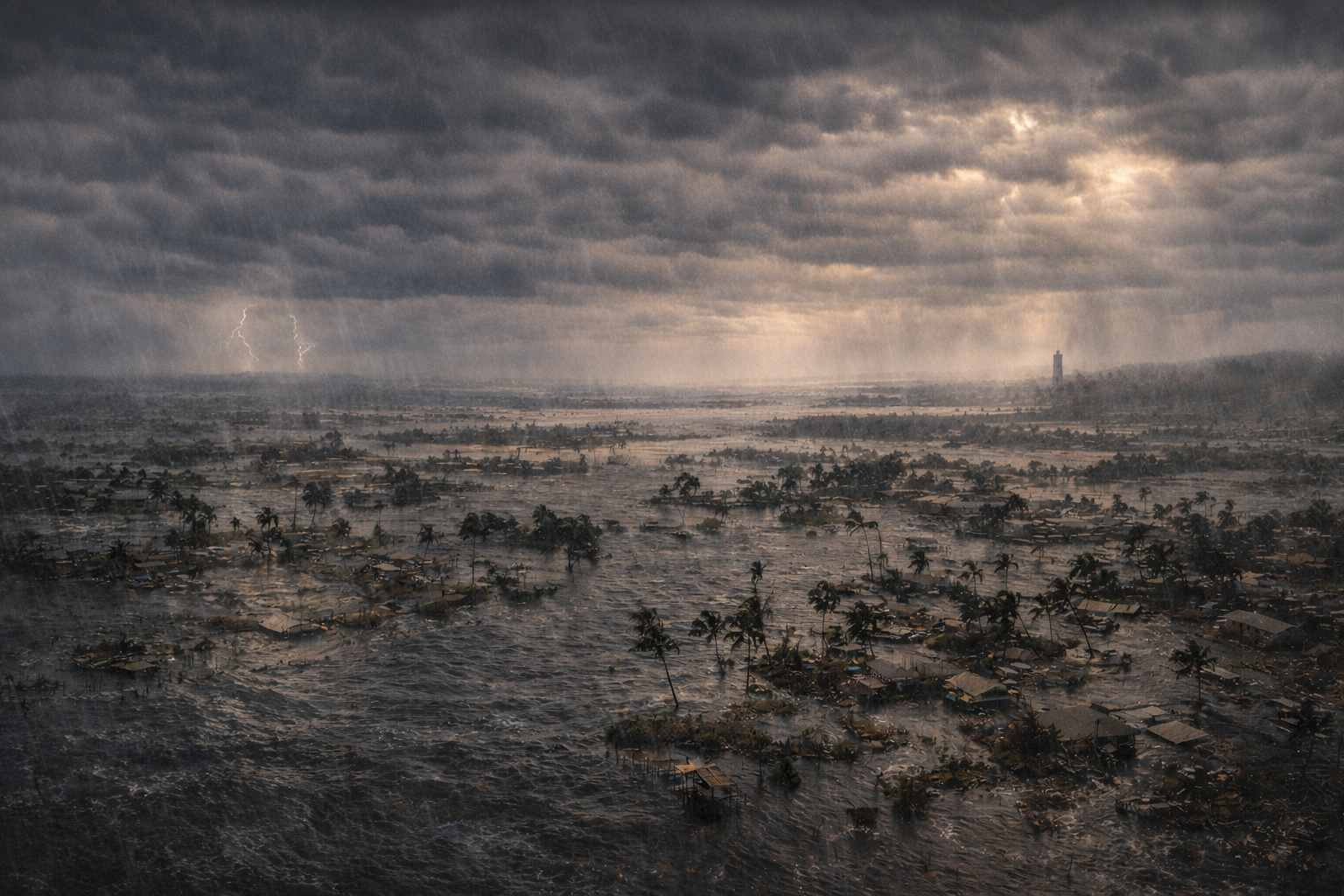
The Archivist brought forward the precedent: Miami 1926, Okeechobee 1928. Florida had been hit before. The Analyst studied what had changed—and what had not. Engineering over restraint. Systems designed to overcome nature rather than accommodate it. The Council watched a state rebuild its confidence faster than it rebuilt its defenses.
THE RECORD · ENTRY SIX
Fort Lauderdale 1947
The Long Water
THE OBSERVER
The system crossed the Florida coast on September 17 with winds near a hundred and forty-five miles per hour. The Observer tracked the pressure falling through the morning, the storm surge building to ten feet, the rainfall measured not in inches but in the behavior of water systems that could not absorb it. The storm killed fifty-one people—a modest number for a Category 4. But the Observer understood that the killing was not the point. The water was the point. It moved inland in ways the region had never experienced. It saturated systems that had been engineered to contain it. The real catastrophe came after the wind stopped.
WHAT THE COUNCIL FOUND
Post-war Florida was booming. Returning soldiers, new retirees, developers chasing profit in subtropical heat. The memory of the 1926 Miami hurricane was fading. Building was accelerating. The Analyst read the target: a region primed for a particular kind of decision. When the 1947 storm demonstrated that water—not wind—was the existential threat, the region chose engineering over restraint. Congress authorized the Central and Southern Florida Flood Control Project in 1948. Canals were dug. Levees built. Pumping stations erected. The project was massive, comprehensive, and transformative. It allowed further development. It also transformed the Everglades in ways that would reverberate for seventy years. The Analyst notes that the most consequential decisions are made in the aftermath, not the impact.
THE RECORD FILES
“The Council watched this decision carefully. A region chose to solve water vulnerability not through restraint or relocation, but through engineering massive enough to remake the landscape itself. The Elder understood the logic, and the Elder understood the cost. Fort Lauderdale 1947 was a hinge point: the moment when technological optimism began to reshape how the nation responded to natural disaster. That choice carried both progress and peril. The Record holds both.”
THE PUBLISHED ENTRY
Fort Lauderdale 1947: The Long Water
READ THE OPENING
September 17, 1947. A Category 4 hurricane crossed the Florida coast with winds near 145 miles per hour, killing 51 people—a modest number for a storm of such power. The real catastrophe came later: the storm triggered a cascade of engineering decisions that would reshape the hydrology of an entire region for generations. The Fort Lauderdale hurricane did not merely strike a city. It forced a reckoning with how humans would try to engineer their way out of natural catastrophe.
HARDCOVER · PAPERBACK · KINDLE · AUDIOBOOK
The Record continues. Fort Lauderdale proved that human response to storms can reshape landscapes. The next entry tracks a hurricane that refused to weaken.
Volume 6 of The Storm Council · 44-Storm Canon · the record Continues