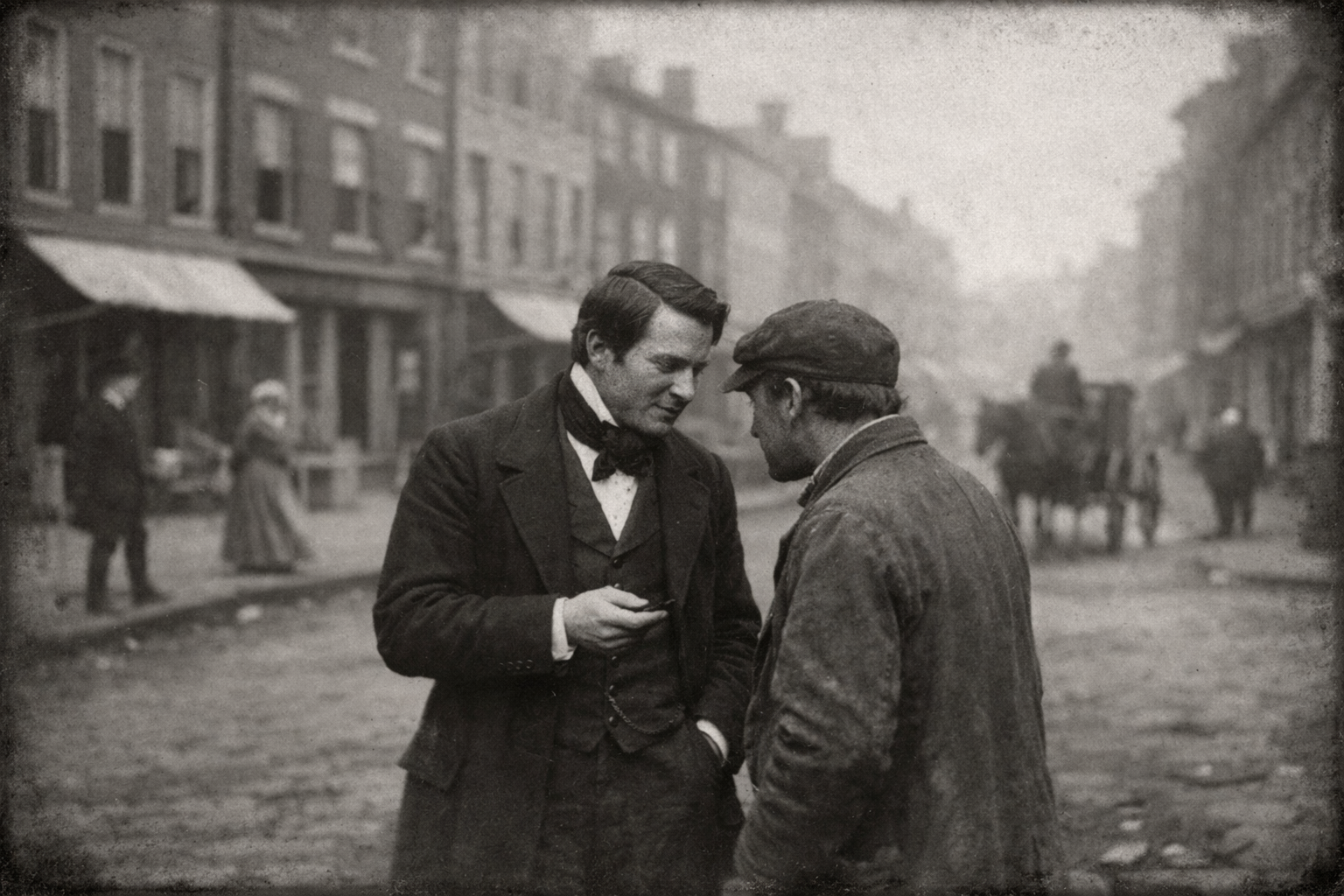
“Have you confidence in me to trust me with your watch until tomorrow?”
— New York Herald, 1849
That question gave America a new way to look at the word “confidence.”
The Storm Council has been watching what that word has done to men and women in South Florida ever since.
How confidence builds cities that boom.
Here’s the question none of them can answer:
What’s the difference between a Confidence Man and a confident man?
Take your time.
The answer is harder than it looks.

The Hardware Salesman
Thomas Grayson arrived in Miami in July of 1926 with twenty-two thousand dollars and a suitcase full of confidence.
The money was the savings of fifteen years selling hardware supplies in Indianapolis — one box of nails at a time.
The confidence was earned and his own.
His brother-in-law, on the other hand, had doubled his money in eight months and sent a letter that said what every letter from a boom town says:
Thomas,
This is real, come now, the window is still open.
Edward
Miami hit Thomas Grayson the way it hit everyone.
The heat, the clear water, the lobby of the McAllister Hotel at breakfast — men in linen suits trading paper across marble tables, the sound of money being made so fast you could hear it in the handshakes.
Trains pulling in from New York and Chicago, packed with buyers who stepped onto the platform and felt what Grayson felt: that they were in the right place at the right time, and the price of admission was just believing.
Grayson wasn’t the reckless or impulsive type.
He applied the same methodical attention to binder contracts that he’d applied to his supply inventory for fifteen years.
What do you hold, at what price, and when do you sell?
The methodology was sound.
The difference, though, was the product.
By the end of September, Grayson had nineteen thousand dollars in option contracts on land he’d never stood on, and no buyers in sight.

The Binder Boys
A binder contract is a ten-percent deposit on an option to purchase Florida real estate.
You put down a thousand on a ten-thousand-dollar lot and hold it for thirty days.
If the land appreciates — and land always appreciates in Florida, right? — you sell the binder to the next buyer at a premium.
You never touch the land.
You’re trading paper on the future price of a place.
The system requires perpetual new buyers.
Not people who want land — people who want appreciation.
People who need to believe the price always goes up.
In other words, confidence.
The moment the train doors open and no new buyers step out onto the platform, every binder in every hotel lobby in Miami is a claim on a price that no longer exists.
They all knew it – the brokers, the bankers, and all the developers.
But nobody said it out loud.
Saying it out loud was more expensive than silence.
You can’t see a Confidence Game while you’re inside it.
You can only see it after the rug gets pulled.

The Confidence Man
That’s why the New York Herald coined the term in 1849 — for a grifter named William Thompson who worked the streets well-dressed and polite, talking to strangers as though they’d met before, until the conversation felt familiar enough to ask:
Have you confidence in me to trust me with your watch until tomorrow?
Many men handed over their timepiece.
Thompson would walk away and never return.
But Thompson was an amateur.
Miami’s Confidence Game was on a whole different level.
Everyone at the table was both the mark and the operator.
Everyone just needed to keep the new buyers coming.

The True Confidence Man
Carl Fisher could see his toes through the water, on the sandbar that would become Miami Beach.
He looked down, saw the bottom, and decided to build a city there anyway.
He dredged the bay, pumped sediment onto the bar, paved it, and built hotels and golf courses and causeways on top of it.
By the summer of 1926, his islands were worth more than one hundred million dollars.
But the plan required a different kind of confidence — not just the confidence to build, but the confidence that the wind and the storms and the surge would bow to his vision.
Because artificial fill on a shallow bottom is only habitable for as long as the ocean decides it is.
And once Fisher sold himself, he had to sell everyone else.
He had to sell a man and his wife on the idea that a sandbar in Biscayne Bay was worth dropping your life savings on — your fifteen years of hard work selling tools, a lifetime of frugal living and sacrifices for your children.
So Fisher brought the celebrities in from New York and the photographers and the golf tournaments.
He put an elephant on the beach.
He built the Flamingo and filled it with the kind of people whose presence told other people this sandbar was more than what it was in the eyes of the ocean that enveloped it.
Fisher didn’t just believe it himself — he made believing it the price of admission, and then he made the admission look like a privilege.
That’s what a real Confidence Man looks like.
Not a grifter with watches.

The Banker Who Knew the Score
Ed Romfh had been President of First National Bank long enough to know what the numbers meant before anyone said them out loud.
By June of 1926, the loan concentration in real estate was past anything the balance sheet could justify.
Romfh didn’t need a crash to see it — he just needed a pencil and the ledger.
The deposits were leveraged against property values that required the same thing everything else in Miami required: new buyers, at higher prices, forever.
Confidence
He closed the ledger.
He didn’t mention it to anyone.
And every morning at nine o’clock, he opened the doors of the bank and let the confidence in — because the confidence walking in was the only thing keeping the confidence from walking out.

The Builder on the Ridge
George Merrick didn’t build on a sandbar.
He built on the ridge.
Coral Gables rose on solid limestone, five miles inland from Fisher’s folly on fill.
These were Mediterranean Revival mansions, masonry walls, Spanish arches, planned from a vision Merrick had carried since boyhood on his father’s citrus grove.
He’d built the one development in South Florida that was designed to outlast the storms and the speculation.
But Merrick had financed this vision with bonds.
And the bonds traded in New York.
And the men in New York who bought the bonds didn’t know the difference between a ridge and a sandbar — they only knew the difference between a coupon that paid and one that didn’t.
Merrick’s proximity to Miami Beach was geographic.
His complicity was financial.

First It Happens Slowly
The game was already cracking before the storm.
Ships backing up in the harbor since January.
The FEC railroad embargoing freight.
Projects that couldn’t get materials couldn’t finish on schedule.
The northern press turned skeptical, and the smart money quietly headed for the exits.
But the game continued, because of a simple equation for every person still holding a binder contract:
The cost of admitting the game was over > The cost of playing one more round.
That’s how the “first it happens slowly” part works.
The part that looks like madness in retrospect but looks like simple math in the moment.
And that is why the “then it happens all at once” always follows.

The Reckonings
The storm didn’t need to destroy the structures to destroy the value.
It only needed to destroy the confidence.
And the confidence didn’t just collapse locally — it rippled across the globe, all at once.
Binder contracts failed in Miami’s hotel lobbies.
Merrick’s bond coupons failed in New York.
Insurance claims were processed in Hartford.
Across the Atlantic, damage reports reached London syndicates who’d underwritten properties they’d never seen.
EVERYONE WOULD HAVE THEIR RECKONING
Fisher stood on Ocean Drive the morning after.
Instead of clear salt water, shards of glass and sand embedded between his toes.
The Flamingo’s roof scattered across the golf course he’d built for the kind of people he’d convinced to come.
Is this what it means to be a Confidence Man?
He walked to the Flamingo.
Found a bathroom.
Turned the tap.
Cupped the lukewarm drops in his hands and pressed them to his face.
When he lifted his head and looked in the mirror, the man looking back was the man who was going to rebuild.
That’s what a Confidence Man does.
The game is exposed for what it is, and The Confidence Man splashes water on his face and goes back out.

Romfh opened the doors of First National at nine o’clock on the Monday morning after the storm.
Same doors.
Same time.
Same composure — the composure of a man whose confidence was itself the most important instrument in the building.
The composure and the confidence were the things that kept the depositors’ money in the bank and the bank’s money in the market and the market’s money in the land.
The ledger he’d closed in June was open now.
And every number in it was worse than the number he’d chosen not to look at three months ago.
Is this what it means to be a Confidence Man?
He kept the confidence going because the alternative was being the man who broke it.
And the Banker who broke it would be the man who destroyed his own bank.
Merrick walked the streets of Coral Gables in the days after and saw something worse than destruction.
He saw survival.
The Mediterranean Revival mansions were standing.
The Spanish arches held.
The ridge elevation had done what he’d told his wife it would do.
His city — the one he’d planned from a boy’s imagination on his father’s citrus grove — was intact.
But none of that mattered.
The market for Coral Gables was the same market as the market for Miami Beach, and the bonds he’d sold were trading in New York, and New York was looking at photographs of destroyed dreams.
The bond market doesn’t distinguish between ideas that were real and ideas that were not.
Merrick defaulted in early 1927.
He’d built the one development that was meant to last, and it didn’t save him.
Is that part of what it means to be a Confidence Man?

Thomas Grayson had the longest reckoning of all — a northbound train from Miami to Indianapolis with a window seat and nothing to do but the hard math.
Fifteen years of selling hardware supplies.
Twenty-two thousand dollars, accumulated with the discipline of a man whose wife watched it grow with the quiet conviction that the accumulation was building toward something.
And a storm had taken most of it.
On that train, Grayson realized the unraveling hadn’t started with the wind.
It had started in Indianapolis, sitting at the kitchen table, feeling something loosen in his chest that fifteen years of steady patience had kept tight.
The intoxication hadn’t started in the McAllister Hotel lobby.
It had started in the letter.
The letter that said this is real, come now — and something in him had already decided to pack his suitcase full of confidence before he finished reading it.
Now the sawgrass was giving way to pine outside the window, and Florida was disappearing behind him, and he had an envelope in his coat pocket with nineteen thousand dollars of paper nobody would ever buy, and a wife on a platform in Indianapolis who’d been reading the wire reports for a week and already knew.
She asked one question when he arrived:
How much?
He told her.
They drove home.
They never discussed it again.
Grayson went back to Hayward & Sons and resumed selling hardware supplies one box of nails at a time.
He held the options for two years.
Sold them in 1928 for eleven hundred dollars — six cents on the dollar.
Florida was real.
The cost to enter was the part no one fully grasped, until they did.

Confidence Man or a confident man?
Complicity and proximity to a Confidence Game doesn’t make you the Confidence Man.
Grayson was proximate.
He walked into the lobby, bought the paper, rode the wave, and got crushed.
He was a confident man who entered a Confidence Game and lost. That doesn’t make him any less a confident man. Losing is part of the Confidence Game.
Romfh was complicit.
Merrick was complicit in a different way. He built something real, financed it with the same instruments as the speculation, and got dragged down by the proximity. His complicity was financial even though his product was genuine.
But Fisher.
Fisher looked at a sandbar with nothing on it and decided it was a city. He didn’t enter a Confidence Game — he created one. He generated the confidence that everyone else traded on. And when the storm destroyed the thing he built on the confidence he created, he splashed water on his face and went back out to build it again.
That’s not complicity. That’s not proximity. That’s the thing itself.
That’s the difference between a Confidence Man and a confident man.
The Confidence Man: Miami, 1926 is a companion essay inspired by the characters and themes explored in The Storm Council — Miami, 1926 — Storm and Speculation by Robert Pudlock.