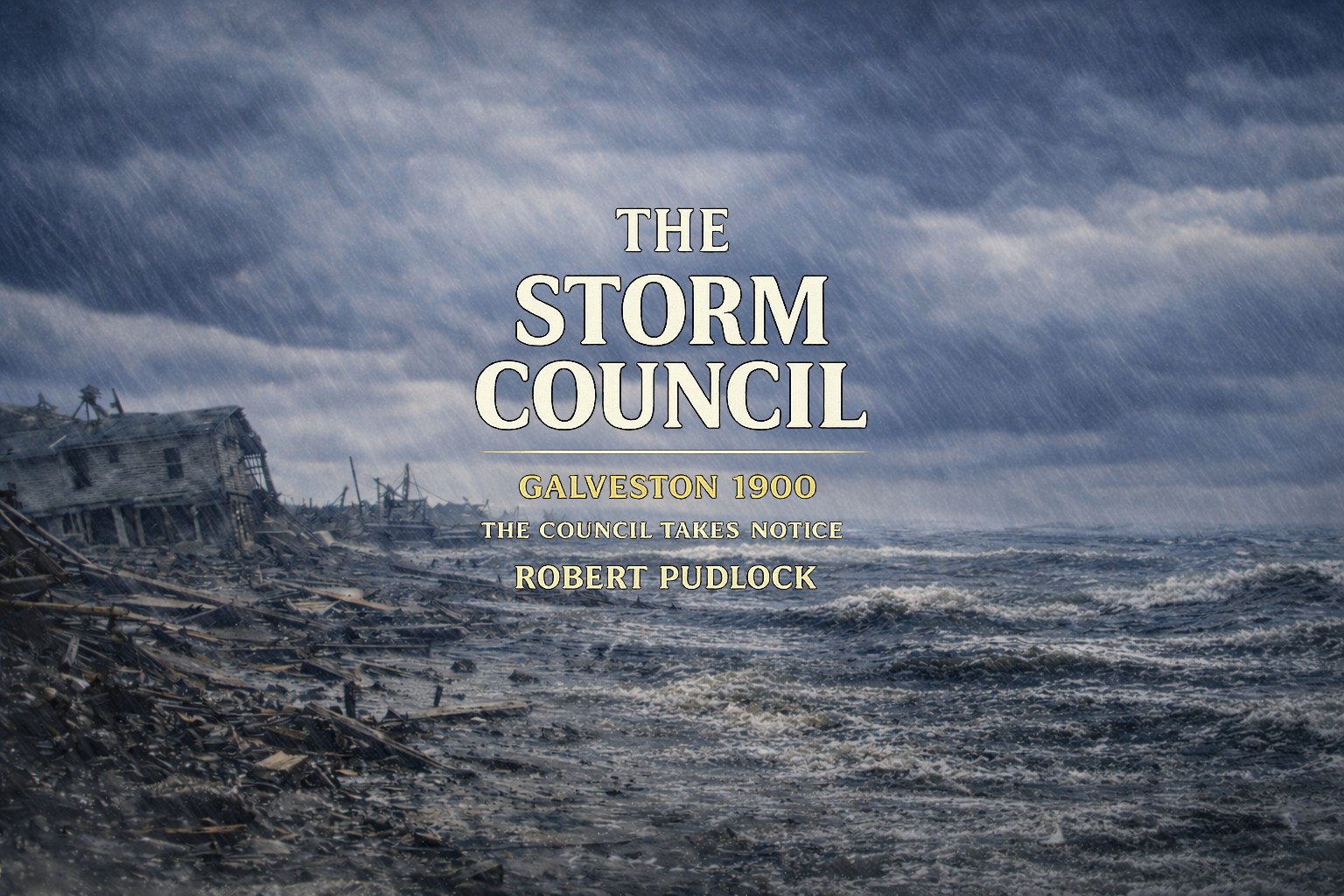
The Council had been watching the island for decades before the storm arrived.
The Observer tracked the atmospheric disturbance.
The Analyst studied a city that had placed its entire population on a sandbar two feet above sea level and called it safe.
The Archivist searched The Record and found no precedent at this scale.
The Council Elder said: Make a record of this.
THE RECORD
Galveston
1900
The Council’s first filed storm.
The storm that opened The Record.
THE OBSERVER
The disturbance organized quietly in the Gulf.
The barometer at the Levy Building read 29.42 at noon and was still falling.
The Observer noted what the instruments could not transmit: the swells rolling in from the southeast, the tide climbing when it should have been dropping, the rain turning horizontal before the Storm had been named.
The target was a barrier island nine feet above sea level.
The Analyst had already made note and was dissecting its areas of likely landfall.
WHAT THE COUNCIL FOUND
Galveston in 1900 was the wealthiest city in Texas.
The port moved more cotton than any terminal in the world.
Electric streetcars ran on schedule.
The city believed it had outpaced its geography.
No seawall had been built.
The argument against it was confidence — the same argument the Analyst would document in Miami in 1926, in Okeechobee in 1928, in every entry that followed.
The Weather Bureau’s chief had published the position that a tropical cyclone could not strike the Texas coast at intensity.
The storm did not read that position.
By evening, the Gulf had risen fifteen feet.
The railroad causeway became a wall that trapped the people it was built to serve.
The wooden houses nearest the water — built with the least margin, holding the working families — disintegrated first.
Between eight thousand and twelve thousand died.
Many were never identified.
The Archivist noted: the dead in the lowest wards were recorded with less permanence than the buildings that killed them.
THE RECORD FILES
“This is where the series begins — not because Galveston was the worst, but because it was the first demonstration that systems fail before structures do. The Council would see these patterns again in Okeechobee, in Audrey, in Katrina. Galveston was the first entry. The Record opened here.”
THE PUBLISHED ENTRY
Galveston 1900: The Council Takes Notice
The first Storm Council volume reconstructs the storm through four analytical voices: the Observer tracking the Gulf’s approach, the Archivist pulling the precedent Galveston had ignored, the Analyst reading the target — the architecture, the commerce, the civic confidence, the missing seawall — and the Council Elder filing what the storm revealed about every coastal city that would come after it.
Built from 200+ primary sources: Weather Bureau telegrams, municipal records, survivor depositions, Corps of Engineers reports.
READ THE OPENING
The barometer at the Levy Building read 29.42 at noon and was still falling. Isaac Cline waded into the rising surf on the south shore of Galveston Island and began telling bathers to go home. He had never seen the Gulf behave this way — the swells rolling in from the southeast, the tide climbing when it should have been dropping, the rain turning horizontal.
By four o’clock the water was in the streets. By six it was in the houses. By eight the houses were gone.
HARDCOVER · PAPERBACK · KINDLE · AUDIOBOOK
Join the Record
The Council doesn’t advertise. It files. If you want to know when the next entry opens — when the next storm is ready — join the Record. Free. No spam. Just the signal.
THE RECORD CONTINUES
A city built on paper confidence. The Council had been watching the target for years.